Your Golf Fitness Roadmap: How To Train Based On Your Game
As you head into spring and start to think about time on the golf course, it is likely you are focused on improving your game relative to last year. Improving your fitness for golf can be the most important change you make for your game. Better fitness will help you drive further, hit more fairways, and play more.
Your golf fitness training should align with your current skill level, whether you are a beginner, an occasional player, or an advanced player striving for scratch. Here is a breakdown of where your focus should be based on your game:
Beginner or Occasional Golfer Focus: Building a Foundation
For individuals new to golf, or those who play infrequently, the fitness objective is to establish a solid, reliable foundation—both in their swing mechanics and their physical conditioning. This foundational work is crucial not only for rapid improvement but also for long-term enjoyment and injury prevention.
On the Range and With an Instructor: When taking lessons, the instruction will center on developing a safe and consistent swing. This involves mastering fundamental grip, posture, and alignment, followed by learning the basic sequence of the swing. The goal here is to eliminate movements that can lead to injury and instead create your swing that ensures consistent contact with the ball. Consistency, not distance, is the initial metric of success

In the Gym: The Golf Fitness Foundation: Similarly, a beginner's approach to golf focused fitness should mirror the simplicity and consistency sought in their swing. The needs are specific: a consistent golf fitness program that focuses on two core pillars:
-
Improving and Maintaining Mobility: Golf requires a significant range of motion, particularly in the thoracic spine (mid-back), hips, and shoulders. Restricted mobility can cause poor swing mechanics and potentially injury. For beginners, mobility work focuses on natural joint movement and flexibility. This involves dynamic stretching, foam rolling, and specific exercises designed to optimize the major rotation centers used in the golf swing. More mobility allows the body to swing without strain.
-
Building Foundational Strength: Strength training at this level focuses on your stabilizing muscles, particularly the core, glutes, and upper back. Developing the necessary stability and endurance allows a repeatable swing motion without fatigue. A strong core acts as the transfer station for power, and strong glutes prevent sway and loss of balance during the swing.
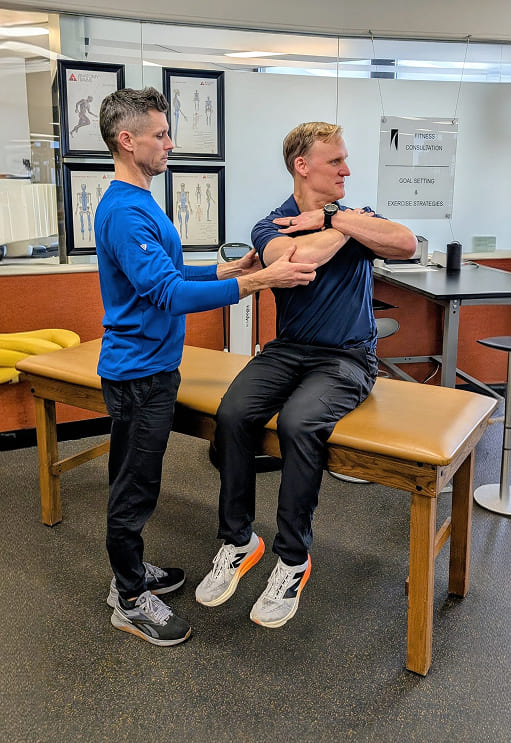
The Golden Ratio of Beginner Fitness: A highly effective guideline for the beginner and occasional player is to dedicate 50 percent or more of your exercise time to mobility, with the remaining time focused on foundational strength work.
-
Mobility Focus (>50%): This commitment ensures that your body can physically execute the moves your instructor teaches you. It is the prerequisite for consistency. Time should be spent on hip rotation, thoracic spine rotation exercises (e.g., Cat-Cow, T-Spine rotations), and shoulder mobility.
-
Strength Focus (<50%): This time should incorporate compound movements such as squats, lunges, plank variations, and controlled rotation exercises. The emphasis is on quality of movement and control, building the 'scaffolding' for the swing.
Working on these two areas will yield powerful and quick results. This dual focus will not only directly translate to better, more consistent contact with the ball and greater control over ball flight, but it will also significantly enhance your overall health, posture, and daily function.
.jpg)
The Intermediate Golfer: Advanced Training for Distance and Control
The intermediate golfer possesses a reliable, consistent swing. Their advanced fitness regimen should strategically enhance their game by focusing on:
-
Improving Ground Force Production (Strength & Stability): Use exercises like squats and lunges to increase the force applied to the ground, a critical component for power transfer.
-
Continuous Mobility Development: Continue building on the foundation of flexibility, particularly in the hips and shoulders.
-
Incorporating Power Training: This is the phase to train for greater distance. In golf, power is defined as the ability to apply maximum force toward the ground, which translates to increased force transfer to the club.
-
Developing Control and Safety (Stabilization & Eccentric Strength): As strength and power increase, it is crucial to learn how to safely manage these enhanced movements. Eccentric strength is vital—it's the body's ability to act as a "brake," allowing the golfer to combine new power and strength safely and effectively.
 1 (1).jpg)
The Golden Ratio of Intermediate Fitness: The intermediate golfer's workout should allocate 40 to 50 percent of the time to mobility work, with the remaining time split evenly between power and strength training.
The Advanced Golfer: Optimizing for Speed, Power, and Resilience
Golfers who have reached the advanced skill level, and intermediate players who have met their foundational fitness benchmarks, are ready to prioritize the development of clubhead speed. This phase involves a continued focus on maintaining existing mobility while actively building rotational power and strength.
Key Training Components For The Advanced Player:
.jpg)
Workout Structure and Recovery For Advanced Golfers: Given the demands of playing multiple rounds a week alongside life's other stresses, a strong emphasis on resilience and recovery is crucial for the advanced golfer.
Meet With A TPI Certified Fitness Trainer:
To elevate your golf game, your fitness regimen must align with your current skill level and future aspirations. The fundamental elements for improvement on the course are enhanced mobility, strength, power, and speed.
Ready to customize your training to your specific golf game? Contact Eric ericb@torontoathleticclub.com or Marv mnixon@torontoathleticclub.com at the Toronto Athletic Club for your personalized golf fitness consultation. Get ready to start playing more, playing better, and hitting the ball farther.
1143